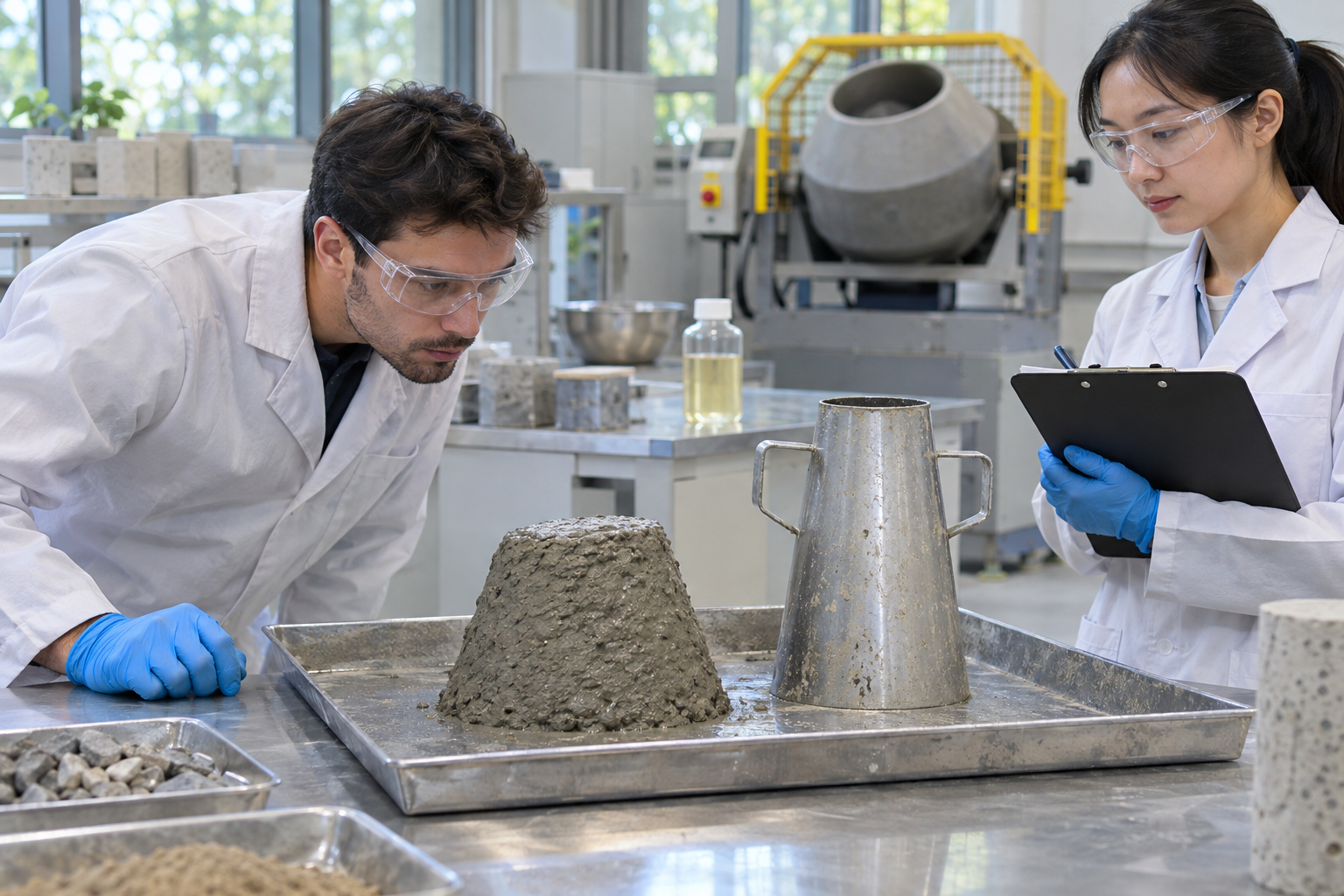
Requesting a polycarboxylate superplasticizer sample is an early step in selecting an admixture for concrete production or formulation. However, a request containing only a concentration and price target gives the supplier limited information for recommending a starting product.
Two buyers may both request liquid PCE with the same solids content while needing different performance. One may require initial dispersion for a controlled precast production cycle. Another may need workability retention through transport, waiting and placement. An admixture formulator may instead require a concentrate for use with other components.
A useful PCE sample request explains the application, materials, performance targets and intended trial conditions. It creates a clearer basis for product selection and makes the subsequent results easier to interpret.
1. State Whether You Need a Concentrate or a Ready-to-Use Admixture
Begin by describing how the product will be used.
The requirement may be for:
A liquid PCE concentrate for further formulation.
A liquid product intended for direct dosing into concrete.
A powder PCE for a suitable dry-blending or concrete application.
Separate components to evaluate water reduction and workability retention.
These supply forms should not be treated as interchangeable.
An admixture formulator needs to assess the product within the proposed formulation. A concrete producer needs a product and dosing procedure suitable for the plant and mix design.
State whether dilution or blending is planned. If a working solution will be prepared, specify the intended concentration and identify any other components that may be introduced.
The supplier can then confirm the product’s intended use and relevant preparation instructions before the sample is dispatched.
2. Describe the Concrete Application and Production Cycle
“PCE for concrete” is a broad requirement. A more useful description identifies the actual application.
Examples include:
Ready-mix concrete delivered by truck.
Precast elements produced in a factory.
Pumped concrete.
Self-compacting concrete.
Low-slump or semi-dry concrete.
For ready-mix production, describe the period from mixing to completion of discharge or placement. Include routine waiting time, rather than only the driving distance.
For precast production, explain the casting process and any setting or early-strength requirements connected with the production schedule.
A strength designation is useful, but it does not replace information about fresh concrete performance and the manufacturing process.
3. Provide Cement and Binder Information
A sample trial should represent the materials that will be used in production.
Provide the cement designation, source and available technical information. If several cement sources are used, identify which one will be included in the initial trial.
Also list separately added cementitious materials, such as fly ash, ground granulated blast-furnace slag or silica fume, where applicable.
A simple binder summary helps prevent misunderstandings:
| Information | What to provide |
|---|---|
| Cement | Designation, manufacturer and source |
| Additional binder materials | Type, source and quantity |
| Total binder | Combined mass used in the concrete |
| Material variation | Whether suppliers or proportions change regularly |
| Trial material | The specific materials selected for sample evaluation |
If cement test data are unavailable, state this clearly. The initial recommendation can then be discussed using the information available, with its limitations understood.
4. Share the Mix Proportions on a Clear Basis
A concrete mix sheet is more useful than a general statement such as “we produce structural concrete.”
Where available, provide quantities per cubic metre for:
Cement.
Other binder materials.
Water.
Fine aggregate.
Coarse aggregate.
Existing chemical admixtures.
Explain how aggregate moisture and absorption are handled in the calculation. If the listed water quantity is a batching-system setting rather than the calculated water used in the mix design, make that distinction clear.
For a laboratory batch, provide the batch size and actual component masses.
The purpose is to establish a reproducible starting composition. A sample comparison becomes difficult when the nominal mix sheet and actual quantities used in the trial are different.
5. Define Workability at Specific Stages
A request for “high water reduction” or “long slump retention” needs measurable context.
Specify the required workability:
Immediately after mixing.
At the expected arrival time.
Before discharge or placement.
At any other relevant point in the working period.
Use the measurement appropriate to the concrete, such as slump or slump flow, and state the required range.
For example, an enquiry can describe a target range at discharge after a defined delivery cycle. This is more informative than asking for a product that retains workability for several hours without stating the required end condition.
Also identify any setting, strength, air-content or stability requirements. Workability retention alone does not establish that the concrete meets the full application requirements.
6. Explain the Current Admixture and Dosage Basis
If an existing admixture is being replaced or compared, provide its product type, concentration where known, and actual addition rate.
The dosage statement should identify:
Whether it refers to the supplied product or calculated solids.
Whether it is based on cement mass or total binder mass.
Whether the addition is measured by mass or volume.
Whether the liquid has been diluted before dosing.
A statement such as “our dosage is 1%” is incomplete without this information.
If dosing is volumetric, provide the density used for conversion or calibration. When concentration is changed, the dosing calculation and water contribution should be reviewed together.
This allows the supplier and buyer to discuss the same quantity rather than comparing percentages with different meanings.
7. Describe the Problem You Want the Sample to Address
A focused description helps distinguish product-selection questions from process or material changes.
Instead of writing “the current PCE does not work well,” describe the observation and when it occurs.
| General description | More useful trial information |
|---|---|
| Poor fluidity | Initial slump is below the target at the stated water and dosage |
| Short retention | Workability falls outside the required range before discharge |
| Unstable production | Results change between batches under the recorded conditions |
| Unsuitable setting | Measured setting behavior conflicts with the production schedule |
| Poor appearance | Surface observations under defined casting and formwork conditions |
Include recent changes in cement, aggregates, water, formulation or equipment.
Photographs can support the description, but measured results and a clear procedure provide a stronger basis for comparison.
8. Include Temperature, Equipment and Mixing Conditions
The trial procedure should accompany the mix sheet.
Useful details include:
Typical concrete and ambient temperatures.
Mixer type and laboratory batch size.
Material charging order.
Water addition arrangement.
PCE dosing point.
Mixing period after dosing.
Sampling and measurement times.
For an international sample evaluation, storage and transport conditions may also be relevant. Confirm the product’s handling requirements before shipment and record any observed change in condition on receipt.
A laboratory trial conducted under one set of conditions should not automatically be treated as a prediction for every season or production setting.
9. Additional Information for Admixture Formulators
If the sample will be used to manufacture a formulated admixture, explain the intended role of the PCE component.
The request should identify whether the main priority is initial dispersion, workability retention or a balance of functions.
Where possible, provide:
The proposed working concentration.
Other formulation components.
Intended mixing and dilution procedures.
Expected storage temperature and period.
Any observed separation or precipitation in the current formulation.
The concrete application used to evaluate the finished admixture.
Compatibility in a stored liquid formulation and performance in concrete require separate checks.
Do not assume that products suitable for use in the same concrete can be premixed as concentrates. Confirm the supplier’s guidance before preparing a blend.
10. Agree on the Trial Plan Before Requesting Sample Quantity
The sample quantity should match the planned testing programme.
Consider the number of candidate products, dosage levels, repeat batches and any formulation or storage checks. Retaining material for follow-up testing may also be useful.
Ask the supplier to confirm the available sample quantity and shipping arrangement rather than assuming that a small container will cover the entire programme.
Before testing, agree on:
The reference product or procedure.
The variables to be compared.
The dosage basis.
The required measurements.
The conditions that define an acceptable result.
Begin with controlled comparisons. Changing several materials and process settings at once makes the outcome harder to interpret.

11. A PCE Sample Request Checklist
The following checklist can be used when preparing an enquiry.
| Enquiry item | Buyer information |
|---|---|
| Intended use | Direct concrete dosing, dilution or admixture formulation |
| Supply form | Liquid concentrate, formulated liquid or powder |
| Application | Ready-mix, precast, pumped or another defined concrete |
| Binder system | Cement and additional binder materials |
| Mix proportions | Component quantities on a stated basis |
| Current admixture | Product type, concentration and dosage basis |
| Workability | Required measurement ranges and time points |
| Other requirements | Stability, air content, setting and strength |
| Production conditions | Temperature, mixer and addition sequence |
| Current problem | Observations supported by trial records |
| Testing programme | Batch size, comparisons and repeat trials |
| Delivery | Sample quantity, destination and receiving arrangements |
Information that is not yet available can be marked accordingly. A clear partial brief is more useful than filling gaps with assumed values.
12. Use Trial Feedback to Refine Product Selection
After testing, share the actual procedure and results rather than only stating that the sample passed or failed.
Include the sample identity, concentration, dosage, mix composition, temperature, initial workability, later measurements and any adjustments made during the trial.
If a result differs from expectations, these records help determine the next comparison. It may involve a different product, a revised dosage or a closer review of materials and preparation conditions.
Shenyang Xingzhenghe Chemical Co., Ltd. supplies polycarboxylate superplasticizer products for concrete applications. Buyers can prepare an application brief using the checklist above to support sample selection and technical discussion.
A well-prepared sample request connects the purchasing enquiry with a practical testing programme. Product suitability is then assessed through representative trials, followed by production verification under the intended conditions.